The Shift: Beyond the Gaming Laptop
For the past four years, my HP Omen 17 was my primary workstation. While it served me well through EPITA projects and gaming sessions, the trade-offs of the “desktop replacement” laptop became impossible to ignore:
- Thermal Throttling: Sustained loads led to aggressive frequency capping.
- Static Hardware: The inability to upgrade the GPU or CPU meant the machine had a fixed expiration date.
- Portability Paradox: It was portable in theory, but its bulk made it a burden in practice.
I wanted a machine that represented efficiency and human ingenuity—a high-performance system in a compact, minimalist footprint. I decided to transition to a Small Form Factor (SFF) desktop.
The Blueprint: Component Selection
Building in a sub-11L case (The T1 Sandwich) is an exercise in spatial optimization. Compatibility isn’t just about sockets; it’s about millimeter-precise clearances for GPU height and CPU cooler height.
The Core Specs:
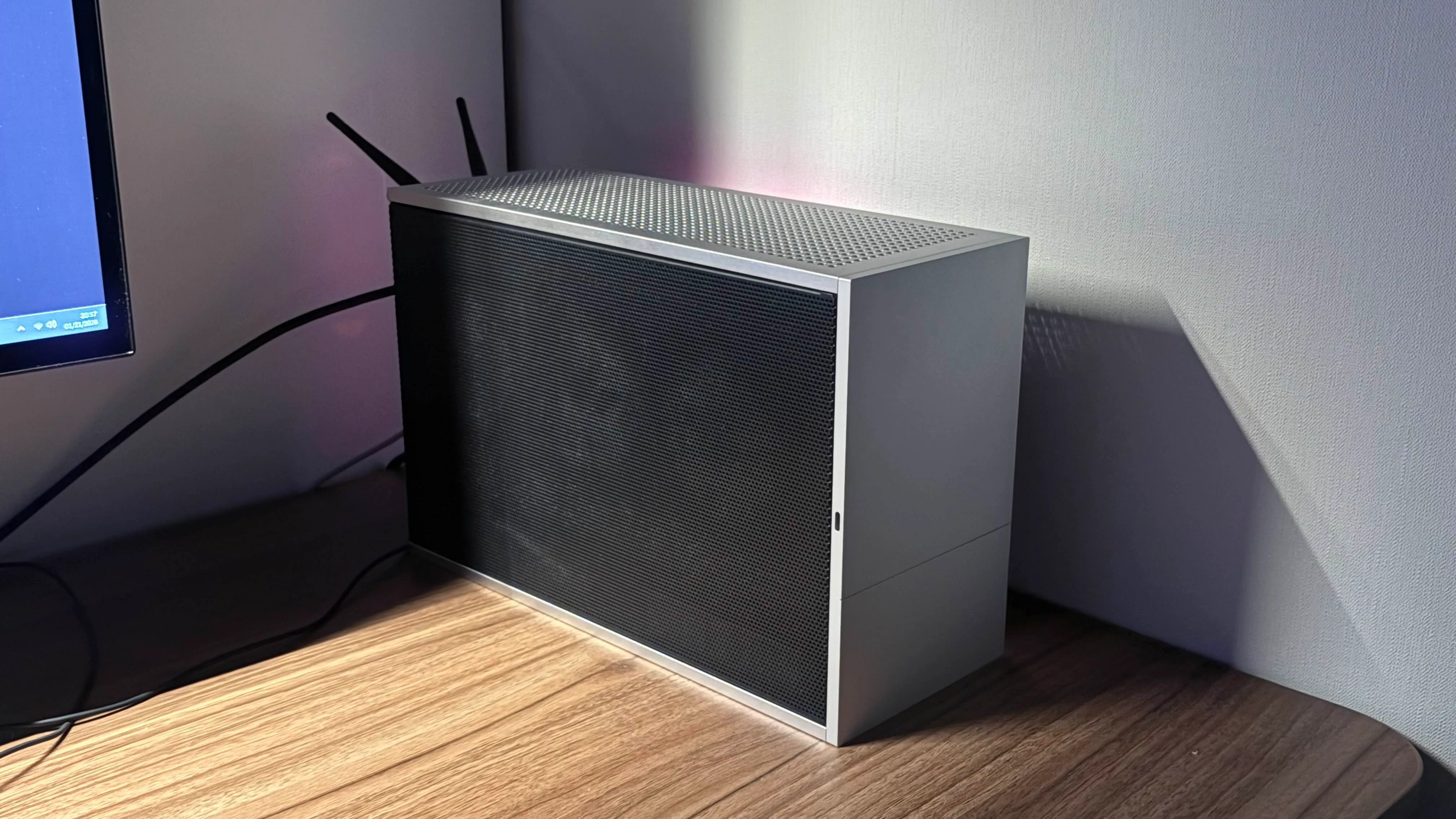
- Case: FormD T1 (Sandwich Kit) – A CNC-milled aluminum chassis focused on airflow.
- CPU: AMD Ryzen 7 9800X3D – The current gold standard for gaming performance.
- GPU: ASUS RTX 5070 Ti 16GB Prime OC – A 2.5-slot powerhouse that fits the T1’s adjustable spine.
- Cooling: Thermalright AXP120-X67 – A low-profile air cooler designed for high TDP in tight spaces.
- Storage: 2TB WD_BLACK SN8100 NVMe (PCIe 5.0) – Pushing 14,000 MB/s read/write speeds.
- Power: Corsair SF850 – Platinum efficiency in an SFX form factor.
The Assembly Challenge
Unlike standard mid-tower builds, the T1 arrives completely flat-packed. I had to build the chassis itself before even touching the electronics.
The primary hurdle was Cable Management. In an SFF build, excess cable length doesn’t just look bad—it kills airflow. I had to route the SFX power cables through the “spine” of the case to ensure the two Corsair RS120 exhaust fans had a clear path to pull heat out of the top.
Success at First Post
There is no feeling quite like the “First Post.” After navigating the BIOS to enable AMD EXPO (ensuring the RAM runs at its rated 6000MHz) and fine-tuning the fan curves for a silent idle, the system was ready.
Conclusion: Engineering for Myself
Building this PC was a lesson in meticulous planning. It mirrored my software projects: researching documentation, understanding the constraints of the “environment” (the case), and optimizing for performance.
The result is a silent, silver beast on my desk that handles everything from the heaviest EPITA compile jobs to 1440p OLED gaming. It’s a reminder that whether it’s a memory allocator or a physical computer, efficiency is the ultimate design goal.
